The Movies’ Digital Future is in Sight and it Works
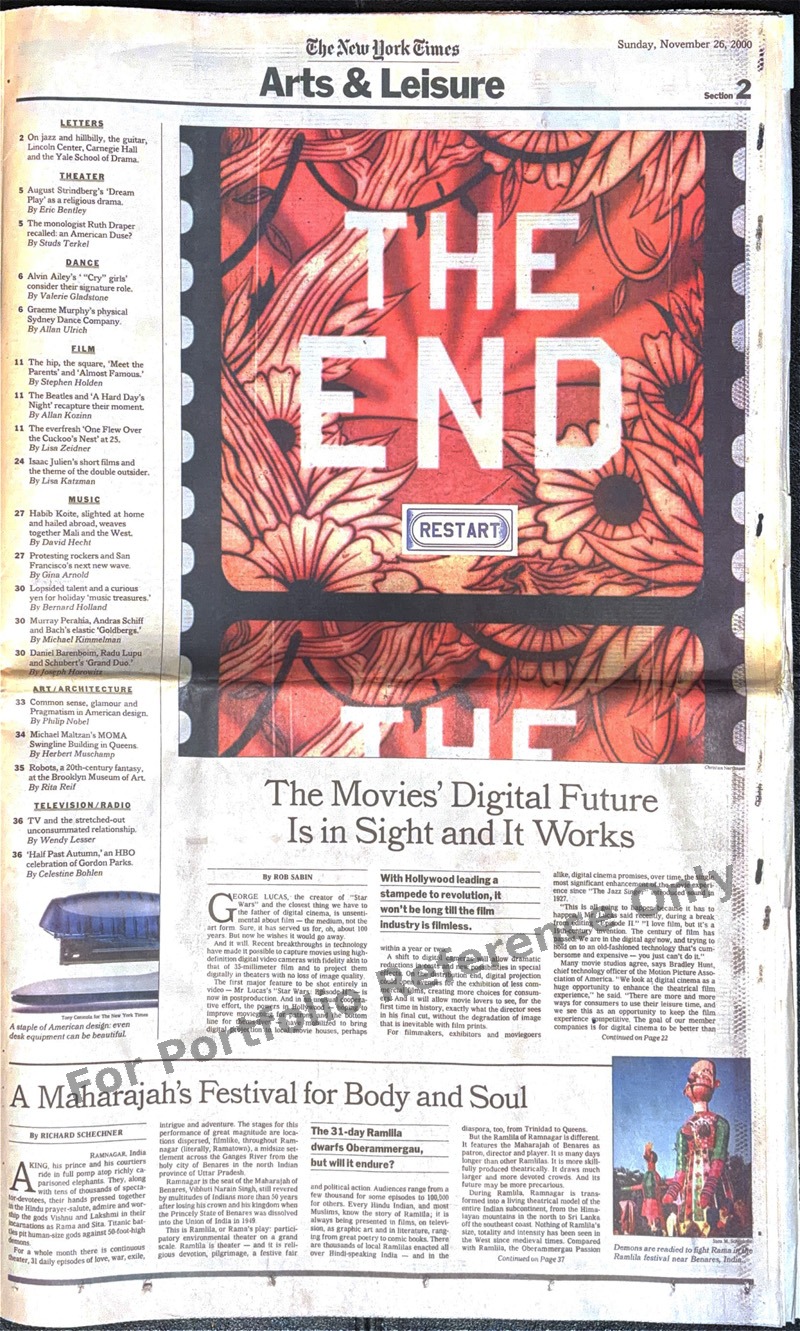
The New York Times, November 26, 2000
This was the lead article of the Sunday Arts & Leisure section for Thanksgiving weekend in the year 2000, and jumped to a full page inside.
I began working with the Times in the fall of 1998 while I was senior editor at Home Theater magazine and was asked to write a home theater primer for an Arts & Leisure fall movie section. This was followed by an assignment in the summer of 1999 to visit two New York area movie theaters doing experimental digital screenings of Star Wars: Episode I – The Phantom Menace, which George Lucas had converted to a digital master to help prove the viability of digital projection. Finally, they reached out to me to do a major feature about the arrival of digital cinema, which was just blossoming into something commercially viable.
The story proved controversial. Although it didn’t break any news that hadn’t already been implied in the movie industry trades, the Times’ very public declaration heralding the pending death of celluloid didn’t go over well with some directors and cinematographers who felt the digital camera technology, in particular, wasn’t ready for prime time. Their reaction was exacerbated by the headline composed by Times editors declaring that the future was essentially here and a subhead that read “With Hollywood leading a stampede to revolution, it won’t be long till the film industry is filmless”—an overstatement, to be sure. The article was further accompanied by an inflammatory lead illustration of a blood red filmstrip with the words “The End” filling each frame. Ultimately, it took another five years before digital cinema equipment standards for capture and exhibition would be finalized by the industry, and more than ten years before digital cameras were widely accepted for shooting major productions.
The full text of this article is available for viewing at the links below from The New York Times archive and may be protected behind a subscription wall. If you have trouble gaining access please contact me at rfsabin@gmail.com or 908-868-4128.
Full text, no images:
TimesMachine print edition with graphics:
Page 1: https://timesmachine.nytimes.com/timesmachine/2000/11/26/319961.html?pageNumber=110
Page 2: https://timesmachine.nytimes.com/timesmachine/2000/11/26/319961.html?pageNumber=547

