Taking Film Out of Films
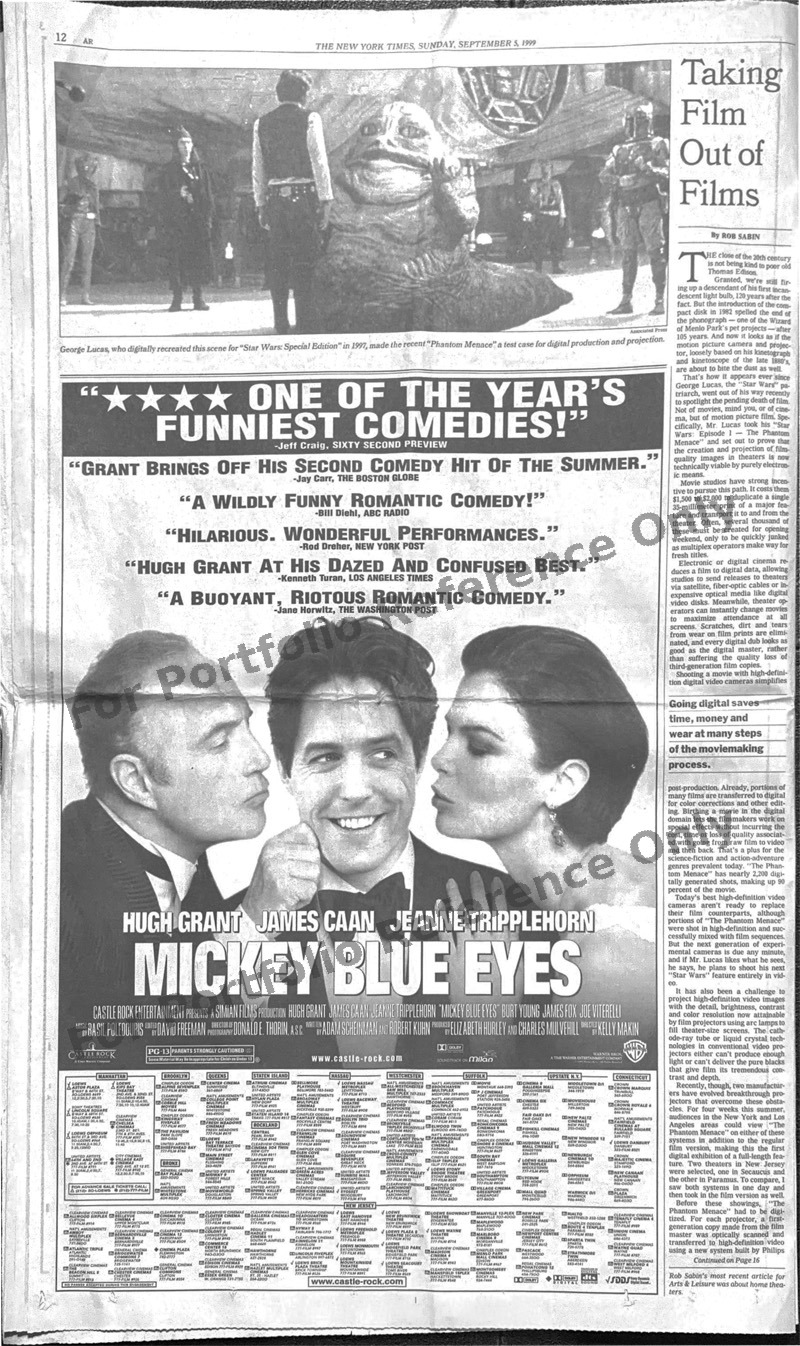
The New York Times, September 5, 1999
In the spring of 1999, George Lucas released Star Wars: Episode I – The Phantom Menace, his fourth installment but the first episode and prequel of his epic saga. Although Lucas had experimented with an early Sony-built high resolution digital camera to shoot some of the scenes in Menace, digital image capture was still in its infancy. But he was just as interested in demonstrating digital exhibition as the way of the future, where the technology was further along and where the potential elimination of film prints promised significant financial and environmental benefits. So he arranged that summer for a limited theater run using two prototype cinema projectors, one relying on Texas Instruments’ Digital Light Processing and the other based on JVC’s Image Light Amplifier. On the east coast, these were playing on screens at multiplex theaters in Seacacus and Paramus, NJ, respectively, which provided the opportunity to view both projections, plus the film version, on the same day. The published piece explained how these technologies work, the subtle differences I saw on screen, and the barriers to adoption. The demo proved to me that digital projection, even at that early stage, would pass the litmus test: average moviegoers would have been unlikely to see any differences with real film.
The full text of this article is available for viewing at the links below from The New York Times archive and may be protected behind a subscription wall. If you have trouble gaining access please contact me at rfsabin@gmail.com or 908-868-4128.
Full text, no images:
TimesMachine print edition with graphics:
Page 1: https://timesmachine.nytimes.com/timesmachine/1999/09/05/291986.html?pageNumber=49
Page 2: https://timesmachine.nytimes.com/timesmachine/1999/09/05/291986.html?pageNumber=53
Page 3: https://timesmachine.nytimes.com/timesmachine/1999/09/05/291986.html?pageNumber=54
 robsabin.com