The Strange Life and Bizarre Disappearance of John Iverson
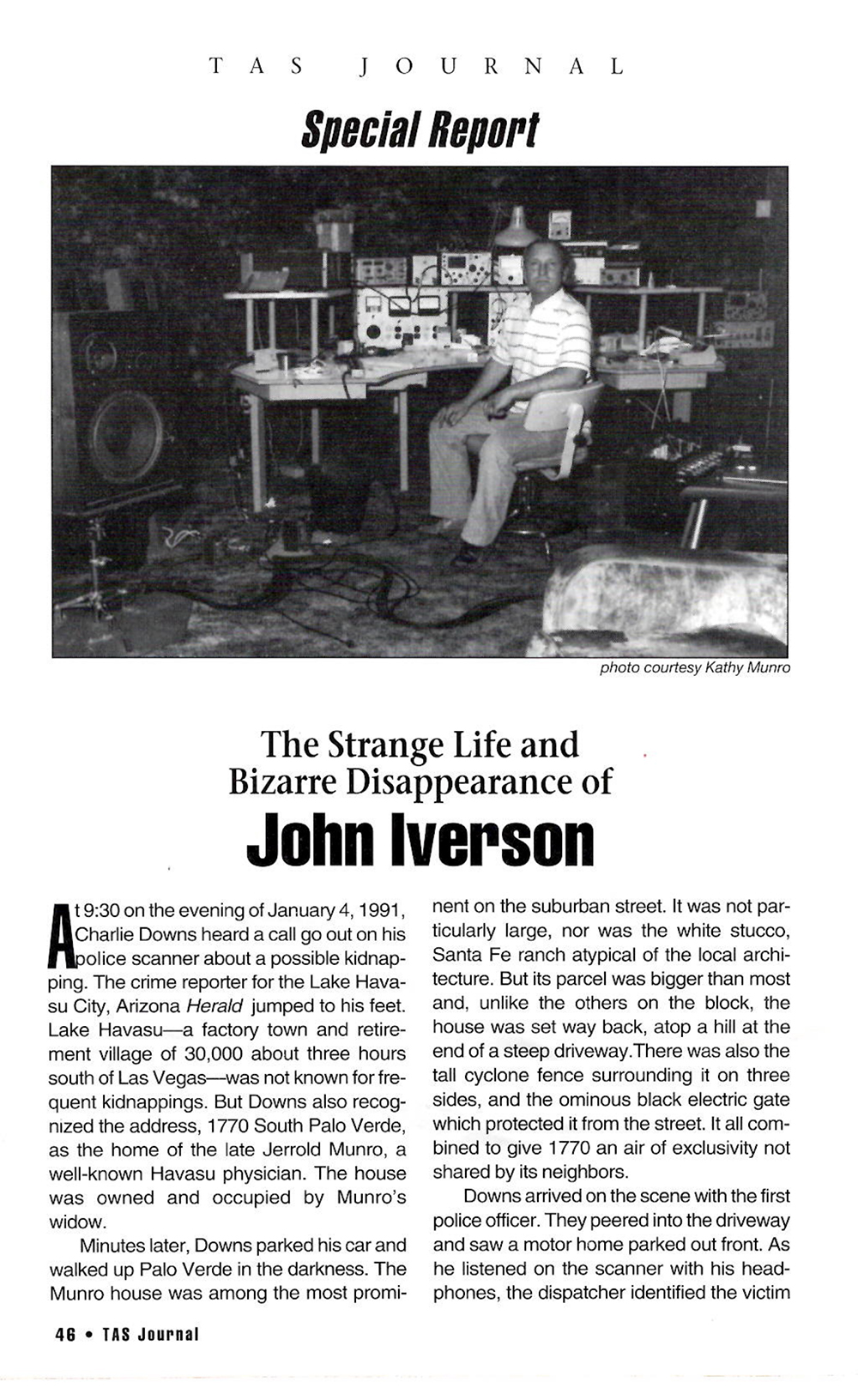
The Absolute Sound, June/July 1994
Even among the wild personalities who populated the early (and some say glory) days of High End audio in the 1980s and 90s, John Iverson was a standout – a loud, profane provocateur who greeted visitors to his Consumer Electronics Show demo room clutching a bottle of Jack Daniels. He was also a genius, a self-trained engineer whose solid-state amplifiers were lauded by critics and whose reputation for thinking outside the box preceded him. So did his penchant for story-telling, to the point where people took for granted that anything he said, particularly about his own past, was suspect. Then, in early 1991, word began circulating that Iverson had been mysteriously abducted from his home in Lake Havasu City, Arizona. A police investigation identified a suspect but failed to determine Iverson’s whereabouts.
Harry Pearson, Jr., editor of the High End audio journal The Absolute Sound, asked me to look into the matter. I reported the story on the ground in Lake Havasu and in California, where I eventually tracked down Iverson’s ex-wife (who had played a role in the kidnapping drama), and interviewed by phone more than a dozen friends, relatives, and co-workers who had known Iverson through the years and could paint a clearer picture of the man. The crazy story that emerged about the night of the disappearance and the days that followed it, cast against the history of Iverson’s life, was “can’t make this up” non-fiction. I never did get definitive proof of what happened to him, but the preponderance of evidence–along with the account of what I deemed a particularly credible source–suggests he faked his own disappearance.

